IQ Option Trading Strategies: For Beginners and Experienced Traders
Whether you have just created your IQ Option account or have been trading for years, having a clear strategy is what separates consistent traders from those who rely on luck. This guide covers the most practical and proven trading approaches available on the IQ Option platform – from momentum-based methods suited to active traders to swing techniques for those who prefer a calmer pace. Each strategy is explained with real-world logic, entry conditions, and recommended indicators so you can apply it right away – starting with the free demo account.
IQ Option gives access to forex pairs, stocks, cryptocurrencies, commodities, indices, and ETFs, all from a single interface. With nearly 20 built-in technical indicators, 18 chart timeframes, and order execution averaging 0.6 seconds, the platform provides the infrastructure – but your results depend on the method you apply. Below, you will find a structured breakdown of the core strategies, the indicators that support them, and the risk management principles that make them sustainable.
Trade on IQ Option online with bonus

Trade on IQ Option online with bonus and explore a popular platform for digital options and CFD trading with fast execution, advanced charts and powerful tools for traders.
Why a Trading Strategy Matters on IQ Option
Trading without a defined method means reacting to price movements rather than anticipating them. A strategy gives you a repeatable framework: defined entry criteria, a clear exit plan, and rules about how much capital to risk per trade. On a platform as fast-moving as IQ Option – where turbo trades can expire in 30 seconds – impulse decisions without a plan rarely end well.
The key benefit of a strategy is not that it guarantees profit, but that it makes your performance measurable. Once you know what conditions triggered a trade and why it worked or failed, you can refine your approach over time. That feedback loop is what separates long-term traders from short-term gamblers.
Before committing real capital, use the IQ Option demo account with its $10,000 virtual balance to test any strategy described here. Treat it seriously – simulate the same position sizes and emotional discipline you would apply with real money.
Trend-Following Strategy
Trend-following is the most accessible strategy for new traders and remains effective for experienced ones. The core principle is simple: identify the prevailing direction of a market and open positions that align with that direction rather than fighting it.
On IQ Option, the most reliable way to identify a trend is through Moving Averages (MA). If the price consistently trades above the 50-period MA, the trend is upward – look for buying opportunities. If it stays below, the trend is downward – look for selling opportunities. Combining a short-period MA (e.g. 10) with a longer one (e.g. 50) and watching for crossovers gives you clearer entry signals.
How to Apply Trend-Following on IQ Option
- Select a major currency pair such as EUR/USD or GBP/USD – these offer more stable trend behaviour than exotic assets.
- Apply a 10-period and 50-period Moving Average to your chart.
- Wait for the short MA to cross above the long MA (bullish crossover) before entering a buy trade.
- Use RSI to confirm the move is not entering overbought territory (RSI above 70 signals caution).
- Set expiry duration to match the timeframe you are analysing – if using a 15-minute chart, a 15–30 minute expiry is appropriate.
Trend-following works best during sustained directional moves. During ranging or choppy market conditions, false signals become more frequent. Check higher timeframes to confirm the broader trend before entering.
Momentum Trading Strategy
Momentum trading focuses on assets that are moving with unusual speed and strength. The idea is to enter early in a strong directional move and exit before it loses steam. Unlike trend-following, which waits for confirmation, momentum trading captures rapid bursts of price energy.
The RSI (Relative Strength Index) and MACD (Moving Average Convergence Divergence) are the primary indicators for this approach. RSI measures the speed of price changes on a scale of 0–100. Values between 30 and 70 suggest a developing move; values above 70 or below 30 indicate an overextended market that may reverse. MACD histogram crossovers signal the beginning of a new momentum phase.
Momentum Entry Example
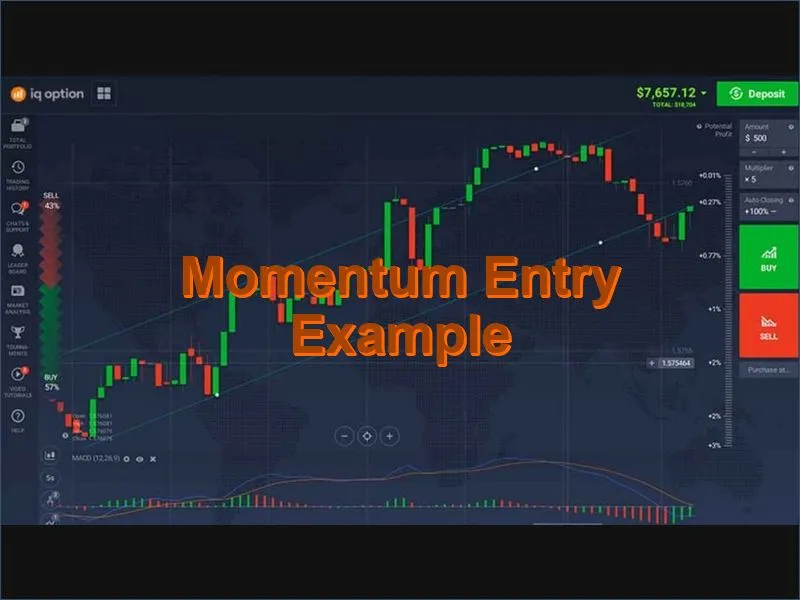
Suppose gold's price rises 1.2% within 15 minutes and trading volume spikes noticeably. RSI climbs from 45 to 62, and the MACD line crosses above its signal line. This combination suggests strong upward momentum. A trader opens an Up option with a 5-minute expiry to capture the continuation of the move.
The risk with momentum strategies is entering too late – after the bulk of the move has already happened. The RSI reading at entry is a useful reference point: entering when RSI is already at 68 leaves very little upside before the market becomes overbought.
Pullback Trading Strategy
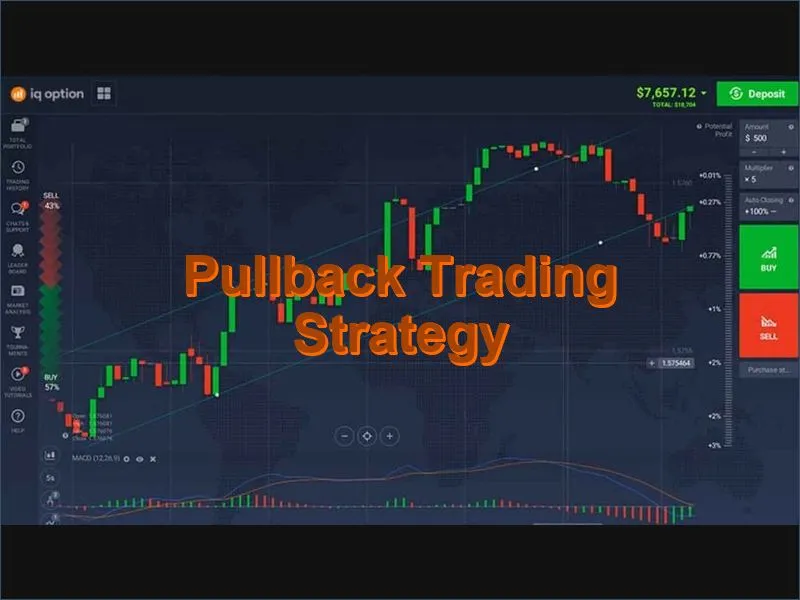
A pullback strategy allows you to enter an established trend at a better price. Rather than chasing price at its peak, you wait for a temporary retracement to a support level before buying into the continuation of the uptrend. This reduces your entry risk and improves the potential reward-to-risk ratio.
The most useful tools for identifying valid pullback zones are Fibonacci retracement levels and horizontal support/resistance. The 38.2%, 50%, and 61.8% retracement levels are the most widely watched. A pullback that holds at the 50% level and then resumes in the original direction is a textbook entry signal.
For example, if EUR/USD has been in a clear uptrend and pulls back toward a prior support level at 1.0850 while RSI dips toward the neutral 50 zone – that combination suggests the trend is pausing, not reversing. An Up option timed to the bounce from support gives a defined entry point with a clear invalidation level below the support zone.
Scalping Strategy on IQ Option
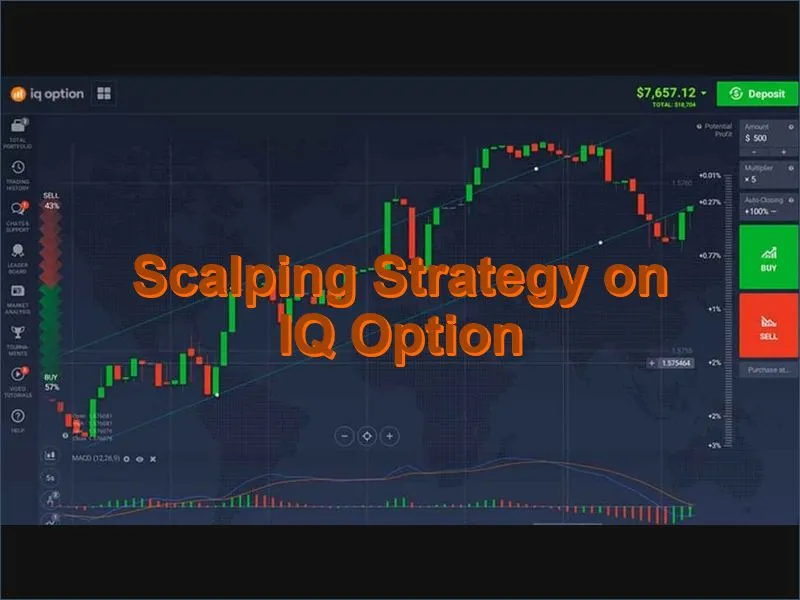
Scalping is designed for traders who prefer high activity and are comfortable making rapid decisions. The objective is to accumulate many small gains across numerous short-duration trades rather than targeting large moves. Positions are typically held for seconds to a few minutes at most.
On IQ Option, scalpers typically use turbo options with 30–120 second expiries, focusing on tight price ranges in liquid currency pairs. Bollinger Bands work well here – when price touches the lower band in a ranging market, a scalper buys an Up option anticipating a return toward the midline. When price touches the upper band, a Down option targets the same mean-reversion move.
Key Scalping Rules
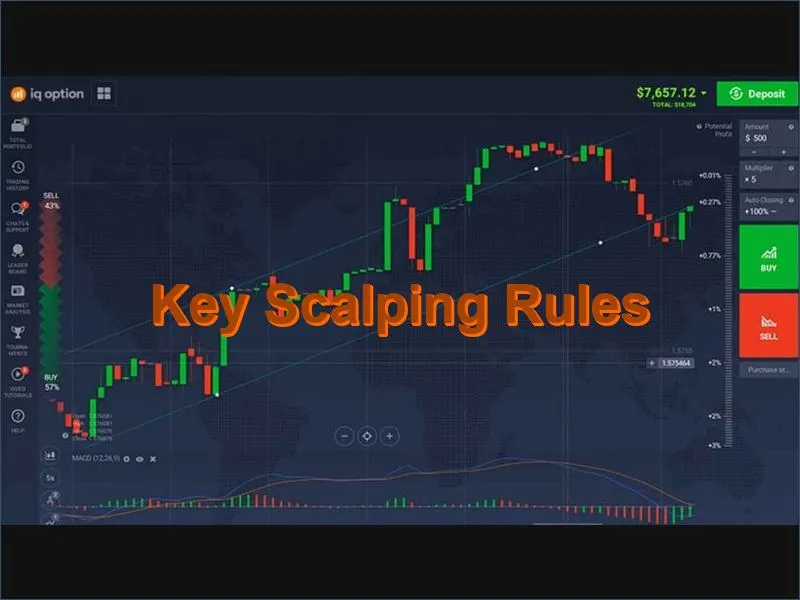
- Only scalp during high-liquidity sessions – London and New York overlap (13:00–17:00 UTC) offers the tightest spreads and most predictable price behaviour.
- Avoid scalping around major news releases – volatility spikes can render Bollinger Band signals unreliable.
- Keep trade size consistent and small – scalping amplifies the impact of transaction costs, so each individual position must be controlled.
- Use a 1-minute or 5-minute chart and apply Bollinger Bands with a standard 20-period, 2-deviation setting.
Scalping demands full concentration and a disciplined stop-loss mentality. It is not recommended as a first strategy for those new to trading – practise extensively on the demo account before applying it with real money.
Breakout Trading Strategy
Breakout trading targets the moment when price moves decisively beyond a key support or resistance level. These moments often signal the start of a new trend phase and can produce strong directional moves – particularly when the breakout is accompanied by elevated trading volume.
The most reliable breakout setups form after prolonged periods of price consolidation. The longer the price has compressed within a range, the more energy is typically released when it finally breaks. Resistance levels that have been tested multiple times without being broken are especially significant when they eventually give way.
A practical example: if a major stock has been ranging between $795 and $810 for several sessions and then closes above $810 with noticeably higher volume than the preceding days, that constitutes a confirmed breakout. A trader opens an Up option expecting continuation above the broken resistance.
One important caution: false breakouts are common. A candle that briefly pierces a level only to close back inside the range is a false break. Waiting for a full candle close above the level – rather than reacting to the wick – significantly reduces the chance of being caught in a fake-out.
News Trading Strategy
Major scheduled economic releases – central bank interest rate decisions, non-farm payrolls, GDP prints, CPI data – routinely produce sharp price movements. News trading involves positioning around these events to capture the directional reaction.
The approach requires both preparation and speed. Before the release, you need to know the market consensus forecast and the previous period's reading. When actual data significantly deviates from the forecast, the market reacts decisively: better-than-expected US employment data typically strengthens the dollar; weaker-than-expected results tend to weaken it.
IQ Option's 0.6-second average order execution makes it well-suited to fast news trades. However, volatility around major releases can be extreme and erratic in the first seconds. Many experienced news traders prefer to wait 30–60 seconds after the release for the initial spike to stabilise before entering – accepting a slightly less optimal entry in exchange for clearer directional confirmation.
Always check the economic calendar before opening positions. Unplanned exposure to a major release while in an unrelated trade is one of the most common causes of unexpected losses on IQ Option. You can also explore available promotions to get additional capital buffer when testing news-driven setups.
Swing Trading Strategy
Swing trading captures medium-term price moves that unfold over hours or days. It is the strategy of choice for traders who cannot monitor charts continuously and prefer fewer, higher-quality setups to the rapid pace of scalping or news trading.
Swing traders focus on identifying trend reversals and continuations at significant structural levels. Chart patterns like head-and-shoulders, double tops, double bottoms, and ascending/descending triangles are central to this approach. These patterns represent shifts in the balance between buyers and sellers and tend to precede significant directional moves.
A typical swing trade might involve identifying that crude oil has completed a correction from a prior high, formed a higher low, and is now showing a bullish engulfing candle pattern on the 4-hour chart. A swing trader would enter an Up option with an expiry of several hours, targeting the return to the previous swing high. The entry is based on structure and confirmation rather than a single indicator reading.
Use 1-hour, 4-hour, and daily chart timeframes for swing analysis. Short-term noise on lower timeframes is less relevant; what matters is the broader directional story the price action tells over multiple sessions.
Technical Indicators to Combine With Your Strategy
No strategy works in isolation – indicators provide the objective data points that confirm or challenge your read on the market. IQ Option includes approximately 20 indicators across its platform. The following are the most widely used and strategically versatile:
| Indicator | Primary Use | Best Combined With |
|---|---|---|
| RSI (14-period) | Identify overbought/oversold conditions | Trend-following, Momentum |
| MACD | Confirm momentum and trend direction | Momentum, Trend-following |
| Moving Averages (10/50) | Determine trend direction and crossovers | Trend-following, Pullback |
| Bollinger Bands (20/2) | Measure volatility and mean-reversion zones | Scalping, Breakout |
| Fibonacci Retracement | Identify pullback entry zones | Pullback, Swing |
| Stochastic Oscillator | Confirm support/resistance interaction | Breakout, Scalping |
Using two or three complementary indicators together produces stronger entry signals than relying on any single tool. For instance, combining Moving Average crossovers with RSI confirmation filters out a significant number of false entries that would otherwise be triggered by MA signals alone.
Risk Management: The Foundation of Every Strategy
Even the most statistically reliable strategy will lose money without proper risk controls. Risk management is not a secondary concern – it is what determines whether you remain in the market long enough to benefit from your strategy's edge. On IQ Option, the following principles should be treated as non-negotiable:
- Limit risk per trade to 1–2% of your total account balance. On a $500 account, this means maximum exposure of $5–$10 per trade. This cap ensures that a losing streak – which every trader experiences – does not destroy your capital before your strategy has the chance to recover.
- Define your exit before you enter. Know in advance how much you are willing to lose on any given trade and at what profit level you will close the position. Decisions made under the pressure of an open position are almost always less rational than those made beforehand.
- Diversify across asset classes. Concentrating all trades in a single pair or market amplifies the impact of adverse events in that asset. Spreading exposure across forex, commodities, and indices reduces correlation risk.
- Never trade to recover losses. The impulse to increase position size after a loss – revenge trading – is one of the most destructive patterns in trading. Stick to your defined position size regardless of recent results.
IQ Option offers negative balance protection and keeps client funds segregated from company accounts. These protections matter, but they do not substitute for personal discipline. According to IQ Option's own disclosures, a significant proportion of retail CFD traders lose money. Sound risk management is your primary defence against being part of that statistic.
Choosing the Right Strategy for Your Profile
Not every strategy fits every trader. Your choice should reflect your available time, risk tolerance, experience level, and the type of analysis you find most natural.
| Trader Profile | Recommended Strategy | Typical Timeframe |
|---|---|---|
| Complete beginner | Trend-following (MA crossover) | 15 min – 1 hour |
| Part-time trader (limited screen time) | Swing trading, Pullback | 4 hour – Daily |
| Active day trader | Momentum, Breakout, News trading | 5 min – 1 hour |
| High-frequency / full-time | Scalping | 1 min – 5 min |
If you are unsure where to start, trend-following on a 15-minute EUR/USD chart with a simple MA crossover is the most widely recommended starting point. It is legible, testable, and builds the chart-reading habits that all other strategies depend on. Once you are comfortable with it, you can layer in additional strategies or explore available bonuses to extend your trading capital as you develop.
Common Mistakes That Undermine Trading Strategies
Understanding what not to do is as important as learning the strategies themselves. The following errors account for a disproportionate share of losses among retail traders on IQ Option:
- Overtrading. More trades do not mean more profit. Entering trades out of boredom or the desire to "make up" a slow session dilutes strategy quality and increases cumulative fee exposure.
- Ignoring the economic calendar. Holding positions without knowing that a major scheduled release is imminent is a form of unmanaged risk. Check the calendar at the start of every session.
- Moving from demo to live too quickly. The demo account exists for a reason. A strategy that performs well on paper for two weeks may react very differently under the psychological pressure of real capital at risk.
- Using a single indicator without confirmation. Every indicator generates false signals. Requiring confirmation from a second, non-correlated indicator before entering significantly improves signal quality.
- Treating tips from social media as strategy. Trading forums, chat groups, and influencer channels regularly circulate unverified signals. Apply your own analysis – every suggestion critically.
After each trading session, review your closed trades. Note which setups performed as expected and which did not – and why. This habit of structured self-review, combined with ongoing use of the demo environment to test refinements, is the most reliable path to improving over time. You can also read the full IQ Option platform review to understand the tool set available to you, or visit the main page for a broader overview of what the platform offers.
Getting Started: Practical First Steps
If you are ready to move from reading to doing, the following sequence gives you a structured starting point:
- Open a free account – log in or register if you are new to the platform.
- Access the demo account and practise your chosen strategy for a minimum of two weeks, tracking your results in a simple spreadsheet.
- Study the platform's chart tools and apply at least two of the indicators listed in the table above to your chosen timeframe.
- Review the deposit and withdrawal options so you understand the mechanics before funding a live account.
- When transitioning to live trading, start with the minimum position size and scale up gradually as your consistency improves.
- Consider using the IQ Option mobile app to stay connected to your open positions and the economic calendar throughout the day.
Trading is a skill built over time. The strategies covered in this guide are the starting framework – your own discipline, ongoing analysis, and willingness to adapt are what will determine your results. Start small, stay consistent, and let your approach evolve with your experience.
IQ Option trading strategies FAQ
What is the best IQ Option strategy for beginners?
Trend-following using Moving Average crossovers is the most recommended starting point for new traders. It is straightforward to apply, works across major currency pairs like EUR/USD, and builds the chart-reading habits needed for more advanced approaches. Combine a 10-period and 50-period MA and enter trades only when they align with the crossover direction. Always start on the demo account.
How much capital should I risk per trade on IQ Option?
The standard guideline is to risk no more than 1-2% of your total account balance on any single trade. On a $500 account, this translates to $5-10 per position. This limit ensures that a series of losing trades - which every trader encounters - does not deplete your capital before you have the opportunity to recover through your strategy.
Can I use multiple strategies at the same time on IQ Option?
Yes, experienced traders often apply different strategies to different assets or timeframes simultaneously. For example, a trader might use swing trading on daily EUR/USD charts while scalping on 1-minute GBP/USD during the London-New York overlap. However, beginners should master one strategy thoroughly before combining approaches, as managing multiple frameworks at once requires strong discipline and chart-reading fluency.
What is the difference between scalping and swing trading on IQ Option?
Scalping involves opening and closing many short-duration trades - often with 30 to 120-second expiries - targeting small price movements in highly liquid markets. Swing trading takes the opposite approach: fewer trades held over hours or days, targeting larger structural moves. Scalping requires constant attention and fast decision-making; swing trading suits traders with limited screen time who prefer to analyse the broader market context.
How does the IQ Option demo account help with strategy testing?
The demo account provides $10,000 in virtual funds and full access to the same charts, indicators, and assets as the live platform. It allows you to test any strategy described in this guide without financial risk. Treat virtual trades with the same discipline as real ones - same position sizing, same entry rules, same exit conditions. Two to four weeks of consistent demo performance is a reasonable benchmark before transitioning to live trading.
What indicators work best for breakout trading on IQ Option?
Volume is the most important confirmation tool for breakouts - a price breach of a key level accompanied by above-average volume is far more reliable than one occurring on low activity. Bollinger Bands help identify compression periods that often precede breakouts: when the bands narrow significantly, a sharp move in either direction tends to follow. The Stochastic Oscillator can help confirm whether the breakout has momentum behind it or is likely to fade.
Is news trading suitable for inexperienced IQ Option traders?
News trading carries higher risk than most other strategies due to the extreme and sometimes erratic price volatility that follows major economic releases. It is generally better suited to traders who already understand how to read price action and can act decisively under time pressure. Beginners are advised to first build experience with trend-following or pullback strategies, then add news trading as a supplementary approach once they are comfortable with the platform and basic technical analysis.